Monday, March 14, 2011

Carnevale

When I got back to Rome a few weeks ago, there was a light spray of confetti all over the sidewalks. It was a little puzzling. It was too late for it to have been left over from New Year’s. St. Valentine’s Day is celebrated over here but hardly to the point of confetti (By the way, St. Valentine’s skull is on display in a church down by the Tiber. The skull has a little cloth name tag attached to its forehead as if his mom were concerned he would get it mixed up with all the other kid’s skulls at summer camp.) It seemed way too early for any pre-Lenten celebration but, it turns out, that’s what it was-Carnevale, the Italian run up to Lent.
Carnevale basically means “farewell to meat” and, like Mardi Gras, it’s a period of celebration before the self-denial of Lent. Also like Mardi Gras the official period begins shortly after Christmas (historically Carnevale began on St. Stephen’s Day, Dec. 26) but doesn’t really ramp up until the last few weeks before Ash Wednesday. Actually, in Rome, it doesn’t really ramp up at all. There’s a bit of a blow-out the final Tuesday but it’s mostly celebrated by kids. Weekends find groups of kids in costume (pirates seem particularly popular) running around throwing confetti but it’s pretty low key. If you’re looking for a celebration, you have to go to Venice.
Venice’s Carnevale tradition started back in the 12th century as a by-product of one of those religious vs secular squabbles that Italy used to specialize in. In this particular case, Ulrico of Aguileria was turned over to the Doge (think Duke) and later ransomed for a bull, 12 hogs, and a promise to make a similar gift of livestock for the next 200 years. The meat was used for a grand public feast that eventually migrated to the Tuesday before Lent and the rest is Carnevale.
The tradition survived until the latter part of the 18th century when Venice was absorbed into the Austrian Empire. Carnevale as a public event was basically outlawed as a number of traditions associated with the revelry were banned, particularly the wearing of masks throughout the city. Carnevale continued to be celebrated at private parties until the latter half of the 19th century when a number of regional practices fell by the wayside during Italy’s reunification movement. The tradition was only brought back as recently as 1970.
While the official Carnevale season begins right after Christmas, the real celebration lasts for 10 days (I was there for about 1.) and is inaugurated with the Angel Flight in which some local celebrity is strapped to a harness and slowly sent down a wire that runs from the top of St. Mark’s bell tower to the stage set up on the far end of the square. Now I have a virulent fear of heights so this strikes me as a curious honor but its origins are even more perverse. Originally it was a handful of prisoners who were given the, ahem, opportunity to crawl or walk down a wire strung from the tower to the entrance to the Doge’s palace where they could present a request for clemency. As you can imagine, the spectators weren’t gathering to witness the freeing of these prisoners but more the consequences of the inevitable misstep.
The most common feature of Carnevale is the mask. Masks feature prominently in Venetian history. Once a thriving shipping and merchant city, Venice population was easily divided along social and economic lines. Masks became a great equalizer and anyone, rich or poor, could enjoy anonymity and even equality under a mask. Masks were worn at numerous times of the year and for varying purposes, social occasions as well as activities that warranted some privacy, amorous affairs, of course, but also visiting the hospital bound or those who had sought refuge in convents.
Of course, having a large part of the population walking around in masks presented some problems and there were plenty of laws governing their use. In the first place, masks were only allowed to be worn during around six months of the year (which is still a lot). In addition a number of laws were enacted to control their use. No one wearing a mask could be armed (makes sense. Men could not mask as women and vice versa. (This one is no longer enforced, at least not during Carnevale.)
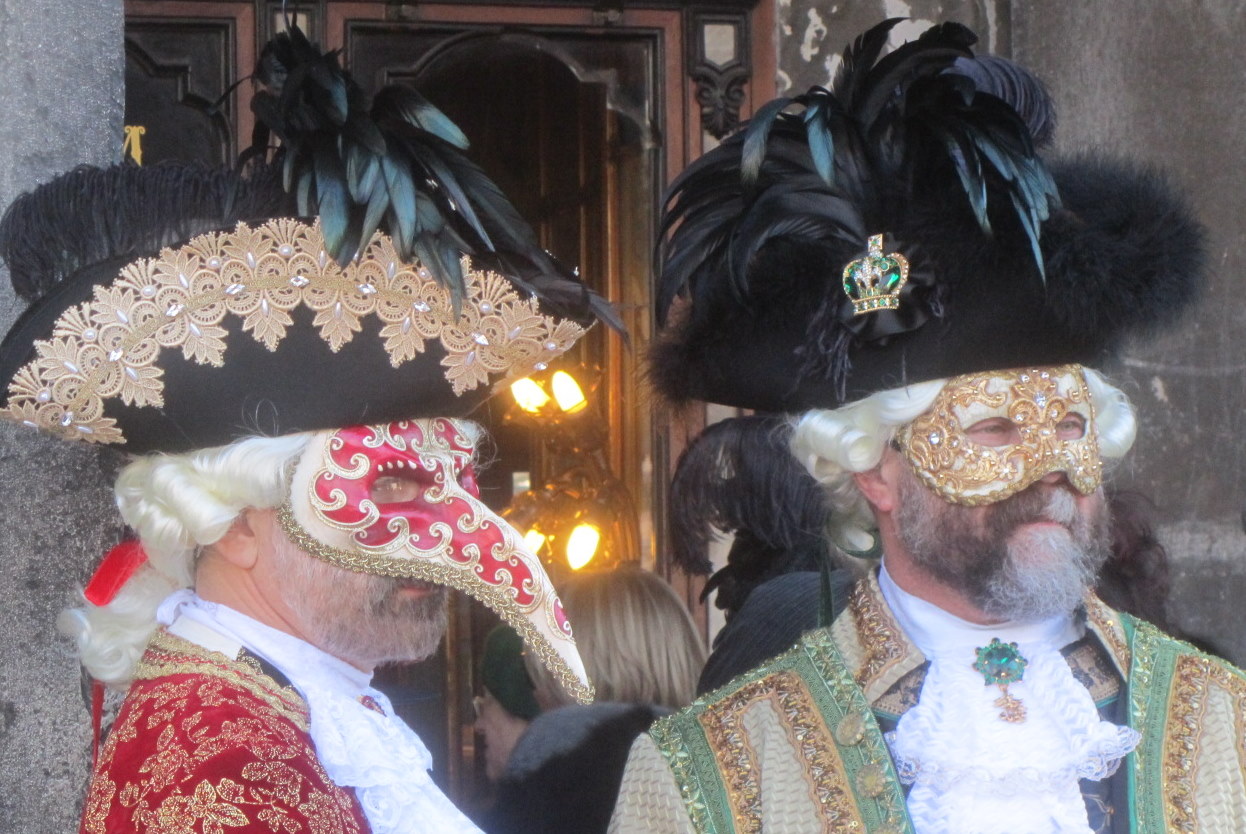
A number of people sport the traditional masks during Carnevale. Far and away, the most popular is the Bauta, a simple mask, either white or black, with eye holes and a sharply jutting jaw that resembles nothing so much as a locomotive cowcatcher. The mask, usually worn with a black tricorner hat and cloak, both allows the person to eat and drink without removing the mask and serves to disguise the voice. Much less common is the Moretta, a simple black oval that covers the face and is held in place by a stub on its back that is held in the teeth (probably why nobody wears them anymore). The Volta, a basic face fitting white mask is popular as is the mask of the Plague Doctor another white mask but with the a long stork like nose. During the plague, most real doctors opted to treat those a little less infectious and another quasi-medical corps was established . These Plague Doctors wore an early form of hazmat gear consisting of leather breeches, long tightly hooded smocks, a flat brimmed hat and a primitive gas mask of sorts. The long noses were filled with aromatic herbs and were intended to filter the air, capturing what were thought to be airborn plague pathogens.
In addition to the traditional masks, there are a good number of people wandering around in the fine brocades and powdered wigs of the Hapsburg era. There are also a lot of folks who look like they’re headed towards the nearest fraternity Halloween party. Some of these costumes look elaborate and uncomfortable(shower stalls, washing machines, etc.) but most are throw aways and toss togethers. Afro wigs, jumbo plastic glasses, and easy to attach devil horns are everywhere. The remarkable thing is that all ages are involved. Kids in strollers are getting their faces painted (sometimes none too happily) and senior citizens strut with silver tipped walking sticks. (Kids also seem to get a real kick out of the confetti tossing and the real little ones gleefully can’t seem to get over the fact that they are actually allowed to throw fistfuls of the stuff into the faces of passing grown-ups.)
Throughout the day there is a constant milling of the costumed and the plain clothed. Venice is a labyrinth, a great city in which to wander aimlessly but frustrating if you’re trying to get someplace in particular. (I was, however, given a great tip for getting around Venice-follow the crowds. 90% of the city’s streets are residential and of little interest to anyone other than the people who live on them. The crowded street s are the ones that go to “places” and usually the ones you want.) The Rialto Bridge and St Mark’s Square seem to be the most common gathering areas but Venice is a city of small squares and piazzas and there’s usually some revelry or street entertainment going on in all of them.
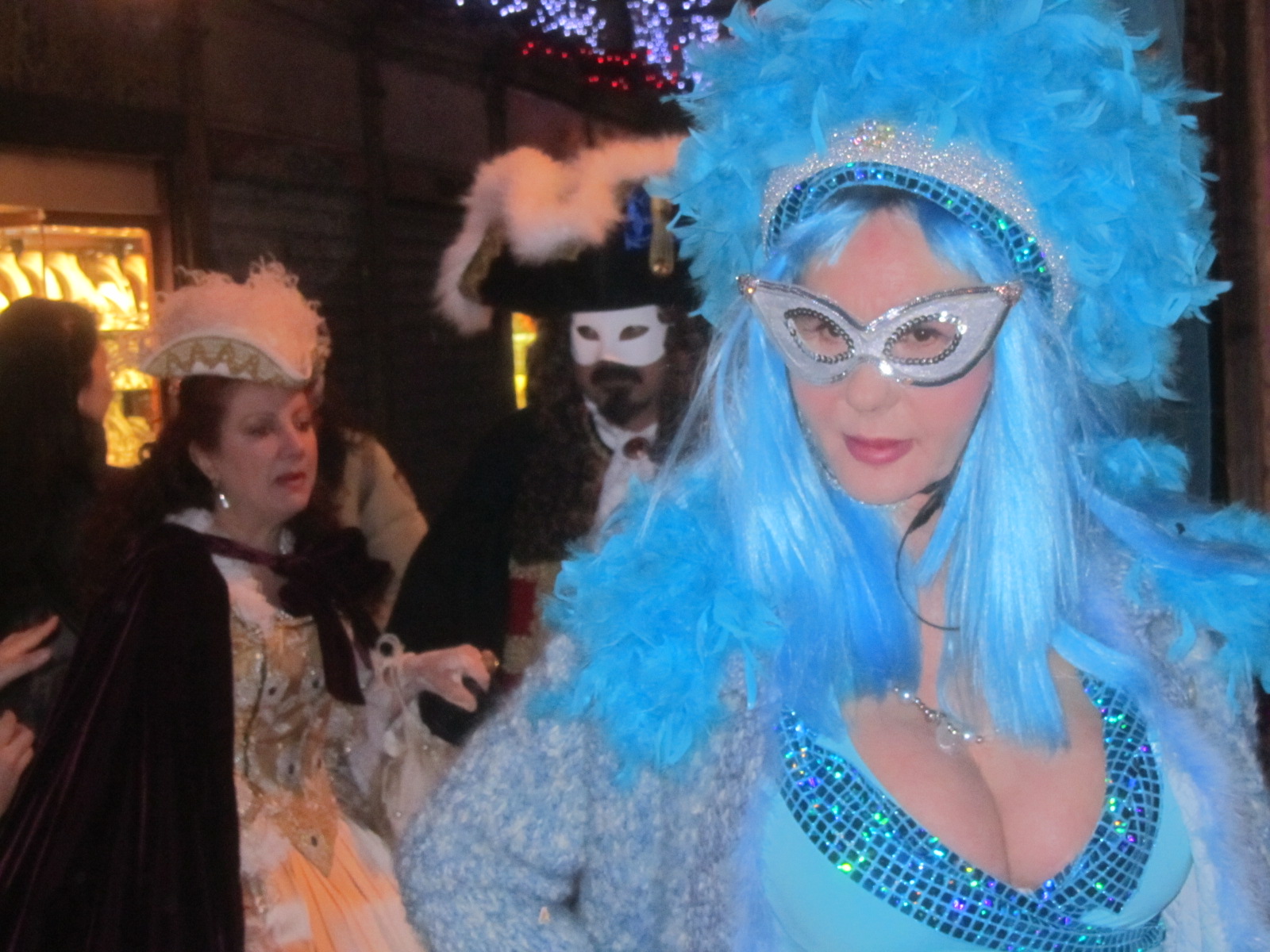
At night, St Mark’s Square is the epicenter. I strolled through about 7 PM and it was already throbbing to Duck Sauce’s Barbra Streisand. (And just what is with that song anyway?) It was pretty clear from the outset that none of these masks were being worn for anonymity’s sake. They were intended to draw attention. Banks of tourists follow the more elaborately costumed like paparazzi, and the costumed adopt an air of indulgence with the throngs as if they put up with this every day. When I first came into the square, a large woman garbed in blue and sporting some imposing cleavage was commanding the attention of a stream of photographers until she appeared to tire of the location, parted the crowd with a wave of her hand and wander off. (Later in the evening I ran into the same woman canalside where she was talking with some friends. She had a voice like Harvey Fierstein and I thought she might have been in drag but I couldn’t quite reconcile the décolletage.
Throughout the square the dance of gawker and gawkee continued. Through the window of one bake shop a group in 18th century garb nonchalantly enjoyed their tea. (By the way, Venice has some pretty impressive pastries, a holdover of the marriage of Italian and Austrian kitchen trends) Outside a man sporting a powdered wig running about 4 ft in height made his way down the sidewalk, trailed by his faithful man servant with shaved head and Taras Bulba topknot, carrying a feather duster and what appeared to be a converted shuffleboard, uh, thing to keep the dandy dust free and his wig erect. Elsewhere, a couple of Johnny Depps, one a dead-on Jack Sparrow, the other the Mad Hatter, worked the crowd in unison. All the while, Euro-disco pumped from towers of loud speakers while a rotating crew of the more elaborately dressed shook it on down on the stage. I think it was a contest but I didn’t stick around til the end. (I barely made it past eight.)
All this is actually a little out of character for Venice, a city with the oldest mean population in Italy, if not all of Europe. The city is often described in the same terms one would reserve for an aging dowager, stately in her decline. Reminiscent of the Savannah of Midnight in the Garden of Good and Evil (come to think of it, John Berendt followed up that hit with a book about Venice) or a pre-Katrina New Orleans on a Sunday morning, the city and its residents usually tend to move slowly, the only offered pace given its curious water-based geography. A friend says that most of the Venetians appear vaguely sedated. The population is in steady decline and the city has particular difficulty holding onto the younger citizenry. Jobs not related to tourism are few and the cost of living is high.
Still, you can’t tell any of that from Carnevale season. It’s vibrant, bustling, and capable of switching from charming to brash in the matter of a couple of steps. Some say that the city is just a few decades away from being one big museum. (Travel writer Rick Steves points out that it’s easy to buy glassware and masks in Venice but tough to find basic household supplies.) For that matter, you can probably make a pretty good argument that the return of Carnevale was an attempt to jump start the tourist season a little earlier and that the whole thing is artificial. On the other hand, it’s important to remember that these traditions do have both feet in history and it’s a unique history at that, so I tend to give it some leeway. I’m a sucker like that.

Wednesday, March 2, 2011

Fatal Charms

Going back to that whole Cleopatra business and farther, Rome has held a certain fascination for things Egyptian. Remnants of that fascination are still evident around the city. Purloined obelisks and Egyptian purple marble can be found all over town. Down a narrow street from the Pantheon, is a yard long stone and sandaled foot, the only visible remains of an old temple to Isis. There’s even a pyramid. There actually used to be several of them but only this one remains. 27 meters tall and built of marble in the 1st Century for praetor and tribune Gaius Cestius, it was later incorporated into the Aurelian Wall that protected and still surrounds the city. At the base of this mammoth tomb sits the Protestant Cemetery.
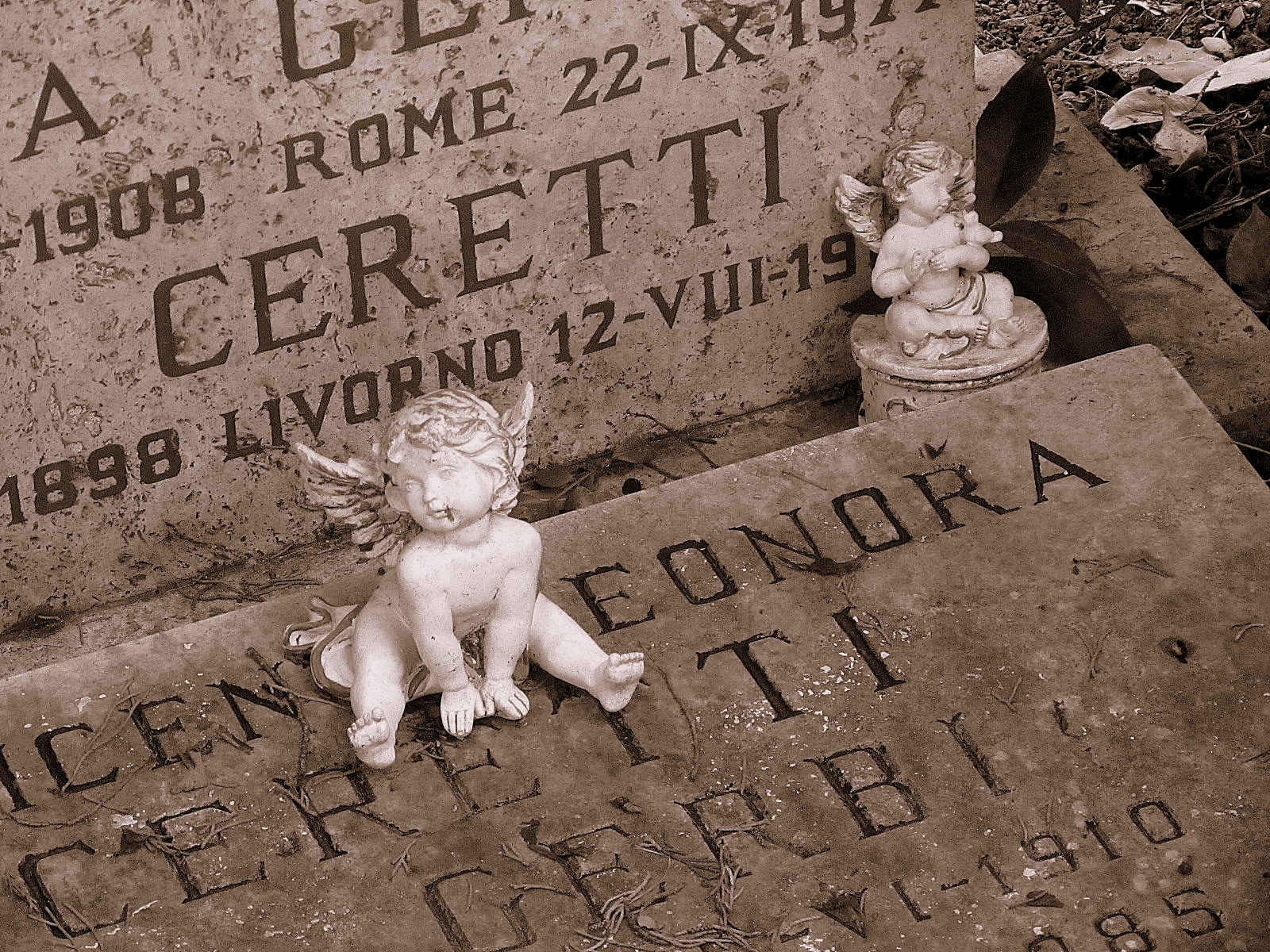
Cimitero Acottolico per gli Straneiri al Testaccio (The non-Catholic cemetery for foreigners in Testaccio) is the final resting spot of around 4000 souls, none Italian and none Catholic. Originally reserved for Protestants and the Orthodox, a scattering of Hebrew and Arabic headstones illustrate the relaxing of those initial proscriptions. The earliest stones date from the 1730’s and the most recent I could find was from 2007. At one time, the Catholic church stipulated that all burials had to take place after dark and reserved the right of censorship over tomb decorations and epitaphs. The cemetery is home to a few luminaries, Keats and Shelley the most prominent (Although actually, only a small but vital part of Shelley is buried here. More on that later.), Mostly it’s filled with folks unknown but no less mourned.
The cemetery is divided into two parts. The Old Cemetery, lying at the base of the pyramid is bright, pleasant, and spacious, dotted with cypress trees. It seems like a great place for a picnic. Shelley wrote that “it might make one in love with death to think that one should be buried in so sweet a place.” The headstones here are lightly spread with lots of green space in between. Off in one corner is the tomb of Keats, a popular visiting spot, although it doesn’t carry his name . Feeling unappreciated by his critics in the months preceding his death from tuberculosis, he fashioned his own epitaph: “Here lies one whose name was writ in water.” Upon his passing, his friends begrudgingly honored his request, editing a bit and adding that the grave contained “all that was mortal of a young English poet who… in the bitterness of his heart at the malicious power of his enemies” opted for anonymity.
Contrasted to the openness of the Old Cemetery, the New Cemetery is shadowy, overgrown, and claustrophobic. In use since 1822 (Keats, dying in 1821, just snuck in across the way), it’s not a particularly large cemetery but it’s bigger than it looks. Planted thick with trees and stones, cramped close together on a sloping hillside, little more than six inches separates its many plots. The graveled footpath is narrow and has a tendency to come and go so that often it’s hard to tell whether one’s on the path or walking across the edge of a grave. Like a number of spaces in Rome, it’s home to a host of stray cats who lend a curious ambiance to the place. There’s something a little unsettling about standing with all those gravestones at your feet, and suddenly realizing that something is brushing against your ankles.
One of the earliest residents, Shelley is buried on the highest ground against the brick wall. Actually, only his heart is buried there. He was cremated after drowning in the Ligurian Sea in 1822 and his heart was brought here for burial by his friend Edward Trelawney. When Trelawney died 59 years later, he was buried a few feet away.
There are a few folks of some fame scattered about. The American sculptor and poet William Story’s last work is Angel of Grief, the statue that adorns the grave he shares with his wife. Julius August Goethe, son of the German author is buried nearby, his name attesting to his father’s love of the city. Mostly though, the names don’t conjure up any recollection of history or accomplishment. Just names. Still, and maybe because of that, the place is fascinating. I’ve spent hours here on a few occasions, picking my way through the stones, calculating life spans and reading epitaphs. Monuments run the gamut from resolute to maudlin to heartbreaking. Many mention the departed’s passing or burial in his or her “beloved Rome.”
I suppose a number of the world’s great cities exert a pull on those outside their culture but Rome seems to be particularly attractive. Part of that is undoubtedly the density of art and architecture it holds in a relatively small space, but I think it’s important not to underestimate the subtle appeal in the fact that it’s all hanging on a spine of ruin. Chunks of marble litter some parts of town and serve as makeshift benches. Old arches and porticos are squeezed by narrow streets. Old columns absorbed by churches just a bit younger.
While the famous monuments attest to the grandeur of the Empire, they also point to the fact that when the Empire fell, it fell hard, only to suffer centuries of sacks and sieges, political infighting, religious power struggles and plain old neglect. Back street curio shops still carry copies of 18th century etchings of the unexcavated forum, cattle grazing amidst the half-buried remains of temples. Grafitti scratches mar wonders from the Colloseum to the Rafael rooms in the Vatican. It’s all very Ozymandian. There’s a certain irony in that Eternal City tag, but there's a certain romance in that crawl towards decay.
A movie called Rueben, Rueben came out twenty years or so ago starring Tom Conti as a dissipated Welsh poet on the slide and working the college circuit while he circled the drain. Towards the end he recites one of his poems (If I remember correctly, the movie was based on a Peter DeVries story so they were probably his words) in which he invites a lover to join him in setting a picnic on the precipice where they can dangle their feet into the void (or something like that). I think that same sentiment gives Rome what Shelley referred to as its “fatal charm.” While it unquestionably sports La Dolce Vita, it does so against a backdrop of tattered and ruined beauty. There’s something charming about the tension between the two.
Late last week a half dozen of us met for pizza. We were saying goodbye to a friend who was moving back to Scandanavia. At one point I looked around the table and realized that with one exception we were all from elsewhere and different elsewheres at that. I was sitting next to a young Russian woman who I knew but not well and we were talking about how we got here. I can’t remember exactly how the conversation went but at one point she said, without melodrama or callous, that she had come to Rome to die. It was a few years ago and she was feeling pretty dissipated herself at the time. The logic was if she was going to wait around for her exit, Rome would be a good place to do it. Thankfully, passing on is no longer on her to-do list and she’s looking to move on (in this life, that is) but the episode echoed that charm. Not necessarily enough to distract one from the passing of time, but enough to keep one occupied.
After dinner I decided to take a stroll. A week or so ago it seemed like spring was about to bloom but this night it was back to winter. Still, it was a dry night and pleasantly crisp and it seemed like a good idea to at least try to walk off that pizza. Eventually I found myself across town on the Ponte St. Angelo, marveling (again) at St. Peter’s dome. A little wind on the water and some pondering of the eternal verities, not a bad way to cap off the evening. Cooler still, twenty feet away a street guitarist was doling out Albinoni’s Adagio. Heck, I could have been thinking about mashed potatoes and it would have still been sublime.

Friday, February 18, 2011

Now, where was I?

Sorry about that unannounced absence. Shortly after Epiphany, I went back to the states for a few months. I had just about finished up an entry about Rome’s post holiday return to normalcy and had every intention of posting it but…well…forgot. When I remembered, I went back and looked at it a couple days ago and there really wasn’t that much of interest in it (Except for the Italian’s curious affinity for tossing things out the window on New Year’s Eve. Mostly firecrackers, which can be tough on pedestrian’s nervous system but also anything that they plan to replace in the coming year, running the gamut from dishes to small appliances to furniture. I have a friend who swears he saw a dishwasher come winging out of a fourth floor window in Naples.). We’ll just let the rest of it go.
Anyway, I was home for about four weeks but now I’m back. Of course the whole idea of home has become a little tricky of late. I mean, I live in Rome and this more and more feels like home; I have friends and routines and haunts, but in the long run, it’s not really home. I’m undoubtedly an American (all the Italians seem to know it) and I know I’ll be heading back to the States before too long (August, it appears) so this is clearly too temporary to be called Home but things aren’t that much clearer over there. All my stuff is in storage in one spot or another, my new driver’s license has me in Maryland, but all my mail goes to Ohio. I am clearly confused or, at best, all over the place.
But here’s a curious thing, at least curious to me. When I was home and talking to people about Rome or just thinking about it for that matter, it seemed so very far away. Now, I’m fully aware of the number of miles (4,462 according to US Air) and the ocean in between but it seemed even farther away than that. Some sort of Brigadoon or alternate reality sort of thing. Some other life holding very little in common with the life I’d been living in the states. The only point of commonality being and, truth be told, I suspect I’m a slightly different person on this side of the Atlantic than on that. Nothing major but little things are different. I’m much more apt to strike up conversations with total strangers over here, for instance. Still can’t whistle though.
Anyway, I’m back in Rome. Took a few long walks around town and everything is pretty much as I left it. (As Tim Cockey pointed out, I left it in ruins.) A noticed a couple of things about Rome while I was in the states. First of all, Rome proper is a small city. I’ve mentioned this before but it was really brought home when I tried to negotiate Baltimore without a car. In Rome, I walk everywhere and it’s no big deal. My first day back in Baltimore, I decided to walk to my doctor’s appointment. It took, well, forever.
Another thing, while Rome’s hectic and crowded, there’s something very light about it. Walking around NYC, I was struck by the fact that it just felt heavier than Rome’s hubbub. Now in all fairness, NYC was still dealing with leaden snow dumps and some major league slush which would dampen anyone’s mood but on average the action is a little more oppressive. (I say this even though my apartment here was burgled in my absence. Nothing of mine was taken, but it does mean that I’ve been the victim of property crime three times in less than ten months. My first hand experience with crime in Baltimore was having an 8-track stolen out of my car which, come to think of it, may have been a favor. Rome, somehow, still feels infinitely safer A friend of mine refers to Rome as “her toy” and I know what she means. The cars are tiny and the motorinos operate at about the same pitch as an electric razor. Besides people are kissing on every other street corner. That tends to lighten the mood.
So I’m back (I keep saying that) and glad to be here. An old friend of mine (and by old I mean enduring as opposed to aged) asked me what I was going back for or to, and I had to think about it. Of course, Rome is a stunning city and I haven’t been here anywhere near long enough to start taking it for granted. There’s also an obvious freedom in this move. The whole notion of me setting most everything aside and going elsewhere for a bit is as surprising to me as it is to anyone else, and there’s something to be said for the pleasant discovery that your world isn’t quite the place you think it was.
It actually reminds me of my college years, and not just in terms of my humble standard of living. We had this thing called a January term, sometimes referred to as a mini-mester, that would be devoted to a single course, often something totally unrelated to one’s usual course of study. The college would offer a number of courses but more often people would design their own and these self designed courses ran the gamut from rigorous scientific research to “Explorations of Hitchhiking as an Alternate Mode of Transportation” or “A study of Leisure in Key West.” As you can imagine, some of these were nothing more than an excuse to blow off and vacate but some were ultimately valuable, sometimes in surprising ways.
The other thing about those January terms was that you only had to do two of them during your four years (This was back when college was a four year proposition.), and most people chose to do them off campus so the student population shrunk by about 75%. As a result, the usual patterns were tossed to the wind and everything seemed, if not new, at least different. New friendships were formed, routines were adjusted and dismantled. The usual bets were off. I used to love it.
So I guess I came back for my mini-mester, a brief detour with some intensive study into history, architecture, and art, before returning to my usual course of study. I know a fair number of people over here who came for a summer a number of years ago and are still here, and most chuckle knowingly when I say I’m only here ‘til August but I don’t see myself staying indefinitely. Setting aside all the realities of visas and licenses, I don’t think I would want to. I’m fully aware that, in some ways, I’m lucky to be unencumbered enough to be able to pop myself out of one life and into another, but I also know that there’s a lot to be said for many of life’s encumbrances.
But enough of that for now. Did I mention I’m back in Rome?

Thursday, December 30, 2010

Auguri!

It’s December 29th as I write this, the fifth day of Christmas. Back home I suspect the holiday is long over, the Christmas season, at least in my experience, begins some time before Halloween and ends shortly after Christmas dinner. Over here, it’s still going strong.
Of course, it starts a lot later over here. With the exception of the fake pine arch that went up in front of the bar down the street around Halloween (and actually, it may have been up year round and I just hadn’t noticed it before), the first signs of the holiday don’t appear until well into December. Dec. 8, the Feast of the Immaculate Conception, is a major holiday and is the usual day for decorating the home and putting up a tree if you have one. (The Christmas tree is not a universal decoration in Italy and, I’ve been told, becomes scarcer as you travel south. Everybody, on the other hand, puts up a Nativity scene.)
The city welcomed the Christmas season at its own pace. Every day something new would appear. I walked into Piazza Navonna on the 3rd to find that they had cleared out the art peddlers and street musicians and had set up what looked like a carnival midway, complete with merry-go-round and games. Booths around the perimeter have been selling crèche figures and La Befana, the witch who fills the stockings of good children on Epiphany. Stalls sell torrone, a seasonal candy of nougat and nuts that comes in both a soft, gummy morbido and a molar cracking duro, as well as candy apples, Nutello smeared crepes (I have unfortunately discovered that Nutello is good stuff), and cotton candy, which on windy nights tends to slip its surly bonds and go wafting through the air. A disreputable looking Santa holds court from his sleigh by one of the fountains.
Throughout the city, decorations went up piece meal. The tree halfway up the Spanish Steps was only partially decorated by the 15th. The Nativity Scene in St Peter’s Square, assembled behind canvas,isn’t revealed until Christmas Eve. The inflatable snow globe next store to the Shwarma Shack didn’t arrive until the 20th. Every walk through town became a little more interesting. I have yet to see an animated Christmas shop window but the wrought chocolate stable at Giolitti’s continues to draw a crowd.
In the ongoing debate between colored and white lights, white clearly got the nod, with a strong contingent of pale blue on a few streets. Via de Coronari (the way of the rosary bead makers), a straight narrow shot from Navonna to the Tiber, is hung thick with strands and stars and looks great, as do a number of the main thoroughfares.
Sadly the weather didn’t always cooperate. A cold snap about 10 days ago froze the water in some of the fountains but it was followed by a warming trend and lots of rain. On Christmas Eve morning the skies opened, throwing down monsoon sheets of rain. (I, unfortunately, was conducting a tour of the Palatine Hill at the time. I’ve never been that wet in my adult life.) Rain pounded through the afternoon but eased around 5. A friend had called that afternoon with tickets to Midnight Mass at St. Pete’s so I was grateful.
Midnight Mass started at 10:00 PM (Don’t ask questions.). The doors opened at 8:30 and we planned to arrive around 8. By then the line already completed a full circle around St. Peter’s Square (which is neither a square nor a circle but it is really big). The wait wasn’t bad. A group of German priest behind us took advantage of the time to practice their hymns and we took turns wandering over to check out the Nativity Scene. (There was a side installation of a Philippine fishing village (the Apostles were fishers of men) that was interesting. Apparently, every year a different country is awarded the honor of adding a temporary addition to the display.) We were inside in no time.
St Peter’s is massive. It’s also one of the few buildings that uses forced perspective tricks to make it appear and feel smaller than it really is. We were sitting fairly close to the aisle and realized when he passed that the pope was a small man but by the time he got to the altar, he was tiny. Choirs were stashed in various side chapels and a small brass choir was perched on a balcony that was w-a-a-y up there. Mass was being broadcast by Vatican TV so the entire basilica was bathed in bright light. The multi-lingual service was hardly an intimate experience but memorable nonetheless. Walking out at the close and gazing down on the square with its massive obelisk and tree was a stunner.
The crowd quickly soaked up the fleet of waiting cabs and the Metro had stopped running at 9 so I was walking but the rain had stopped and it was a pleasant enough night. It wasn’t a lonely walk. In a town of 500 churches, there are plenty of people on the streets as midnight mass is letting out. I stopped off at Piazza Navonna for a candy cane (first of the season, and at 1 Euro a piece, probably the last) and made my way home.
We all have our Christmas traditions and I have mine, so before going to sleep I got on my laptop and sorted through youtube until I found a clip of Darlene Love singing Christmas (Baby, please come home), then fired up my Kindle, hopped into bed and started reading Dickens’ A Christmas Carol. I think I made it to the fourth paragraph.
Christmas day itself was quiet and drizzling. Heading out to a brunch, I would have sworn the town was deserted but as the day progressed, more and more people appeared on the streets and by nightfall, a number of shops had opened. By Sunday, the streets were in full bustle. The rain seemed to have finely cleared away and a bright, jovial, stirring cold had settled in. Everywhere people were wishing each other Buon Natale, the more politically correct Bona Feste, or the all-purpose Auguri, which translates roughly into “Best Wishes” but is far more robust and festive than that meager greeting.
And so it continues. The streets are full of visitors, Santa still is still offering his lap, Carabinari’s, particularly those scheduled by attractions like the Trevi Fountain, have traded in their sub-machine guns for capes and cutlasses and pose with children, and folks are singing carols in St. Peter’s Square. I wandered down to Navonna Tuesday night were a small and mobile brass band was cooking up a second line-Latino hybrid that had driven a bunch of high school kids to spontaneous choreography. It didn’t have much to do with Christmas but it was festive…and what’s wrong with that.
Auguri!

Tuesday, December 28, 2010

Thanks. I needed that.

Originally my opening line was going to be something along the lines of “Truth be told, this ex-pat  business isn’t  always everything it’s cracked up to be” but that sounds really petulant, not to mention naïve, so let’s just say that while it has a lot of highs, it can hit some real lows, which doesn’t exactly qualify as a news flash either. Last time I wrote I was coming off of a really great trip through Turkey. It was a remarkable experience, a real high, but by the time I was writing about it, things had already started to slip a bit.
It started when I took the evening shuttle bus to the Istanbul airport only to discover that my 11:50 flight had left at 11:50 AM (as scheduled, I might add). Now, in my defense I would like to point out that Pegasus Airlines has only one flight daily from Istanbul to Rome and that when I made the trip in August we left a few minutes before midnight, but that’s a weak excuse because over here the airport follow 24 hour time and a flight leaving ten minutes before midnight would be leaving at 23:50. Regardless, there wasn’t a hotel near which meant I was going to be spending the night in the Istanbul Airport.
That actually isn’t that bad of a deal. Heck, when you consider I spent the previous night on a bus, it could even be a step up. The drag was that for the previous couple of days, I’d been trying, with progressively less success, to ignore a burgeoning toothache which was suggesting that here was a root canal in my future. Add to that the realization that the orange tabby that had been hopefully eyeing me while I ate my final Turkish meal had apparently retaliated for my refusal to share by spraying the day pack which, under other circumstances, would have served as my pillow. Sleep was going to be hard to come by.
Anyway, I got through the night and back to the Rome, where, after tossing my pack in the washer, I got re-acquainted with my bed… so, things were looking up, right? Well, not exactly because within the next week I caught some nasty upper respiratory mess, met with a very accommodating Italian dentist who wanted to pull all my remaining wisdom teeth (I think he has some new equipment he’s dying to try out), and ( and here’s the kicker) had my pocket picked in Naples (I don’t really want to talk about it but let’s just say, if you go to get on the commuter train and it’s way too crowded, don’t squeeze your way in, just wait for the next one. Oh, and if you have a money belt, use it fercryinoutloud!)
Now I know it’s unseemly to be complaining when one’s living in the Eternal City, even if winter here can be a cold and rainy thing, but there it is. Any city has the potential to become a just another city from time to time I suppose. At least it does for me. Usually, the antidote for that is a little exploring but sometimes the motivation can be hard to come by. (Have I mentioned that the winter months tend to be cold and rainy?)
Of course, then a touch of homesickness creeps in. I start longing for a big cup of drip coffee in a “to go” cup, speculating what Christmas will be like without the lights of Hampden or Darlene Love on Letterman, and wondering what’s happening on this season of Dexter or 30 Rock or Treme (Is there even a new season of Treme?). I even got pretty close to going to McDonald’s the other day (but I blame that on a scene in Laura Lippman’s latest book.) Anyway, you get the idea. Put it all together and it’s a funk. Nothing clinical but not of any value either.
So, here’s what happened. A couple of days ago I was futzing around the apartment ‘cause it was cold and damp outside but when I looked out the window and it was snowing. Not hard, mind you, but it was more than flurries. This is not a common occurrence over here. Last February a couple of inches fell one morning and the city ground to a halt because no one had seen that for 25 years. A number of friends of mine mentioned that they had taken pictures of St Peter’s dome covered with snow but I had already decided on my destination in case of snow- the Pantheon.
Now it’s a half hour walk from my apartment to the Pantheon and as I set off I’m hoping that I get here before this stops. By the time I get to the Colosseum, just a few flakes are coming down but things start to pick up again as I’m head by the imperial forums. Some even seems to be sticking in the Piazza Venezia which holds the city’s largest Christmas tree. (Great lights on this tree, by the way. In addition to your basic white lights, there are these long (18 “) hanging strips that have a series of small bulbs firing in sequence. The resulting effect suggests shooting stars. Never seen that before.)
Thankfully, it’s still coming down by the time I get to the Piazza della Rotunda. Inside a small crowd has gathered as, apparently, I’m not the only one with this idea. It’s subtle but snow is drifting down through the oculus. I snap a number of pictures but I doubt that it will translate. That’s ok. (It’s gonna have to be). I put my camera back in my pocket and just watch for a bit. Somebody calls my name and I turn to greet a couple of friends of mine who had come down as well. (I’m still surprised when I run into people I know on the streets of the city.) We all just stand there looking up. It’s actually not all that dramatic, I mean you really have to look to see it but, then again, I’m living in Rome, and standing in the Pantheon with friends, and it's snowing. What are the chances of that happening?
(This didn't start out to be a Christmas post but for the last four days, this program hasn't let me load pictures.  So, on the off chance that it works today, I'll close by saying...)
Buon Natale, everyone.

Monday, December 13, 2010

A Second Helping of Turkey

Some things are better the second time around.
I went to Turkey last August or, more accurately, I went to Istanbul. It’s a mammoth city. Population estimates for the greater Istanbul area range from 10 to 16 million people, and while it occasionally looks like a western city (Starbucks, Burger King, Sbarro’s Pizza for that matter), it’s mosques and minarets, head scarves, and five times daily calls to prayer let you know very clearly that you’re not in Kansas anymore. I liked it a lot but also found it intimidating. The language was totally unrecognizable (although there are plenty of English speakers), the population tended to be pretty stone faced, and those that weren’t were trying to sell me a carpet. It was hot, humid, exhausting but, nevertheless, intriguing.
Since that trip a number of people have told me that I needed to see the rest of the country and since it’s prudent visa-wise to get out of Italy every now and then (now and then being every 90 days, long story), I decided to go back and head out into the country. I flew into Istanbul Gokken Airport (it’s in the Asian part of the city) and found an inexpensive shuttle to my hostel. Traffic was murder (as usual) and the trip took three hours (in other words, it took less time to get from Rome to Istanbul than it took to get from the airport to the hotel.) The driver and his sidekick, however, seemed to be having the time of their lives, constantly changing lanes, cutting people off, and driving on the shoulder. Istanbul traffic makes Rome looks organized, traffic lights appear to be merely suggestions, crosswalks are flat-out dangerous, and the alternate merge is a foreign concept.
The highlight of the trip occurred when they flagged down a candy salesman working around one of the toll plazas. They bought two boxes of whatever he was selling and passed them around the van. It appeared to be the Turkish version of cotton candy but more brittle (candy fiberglass insulation would be close). It tasted of sugar with a hint of some kind of grain in there as well. The candy was forgettable but I still can’t get over the fact that the guy was running around highway traffic selling it. (Ok, it was congested highway traffic, but still. This would be like working as a squeegee kid at the Delaware Memorial Bridge.)
I eventually got to the hostel, checked in and headed out to wander. I was staying in Sultanahmet, the old part of the city. I walked over a few blocks and cut through the road between the Blue Mosque and Sofia Haj. It’s hard to grasp how massive these two buildings are. At first glance they appear to each be hunkered down on respective hills but under further inspection it becomes clear that each is the hill, that beneath the main body of each mosque is a cascade of smaller domes and roofs that support them. The Sofia which was desanctified years ago and is now a museum looks a little worse for wear by day but by night, it holds its ground impressively.
I grabbed a kebab at a nearby restaurant, and then stopped at one of the sidewalk vendors who was ladling out what was described as an Ottoman era winter health beverage made of milk, honey, and spices. It tasted like a thinned version of egg custard. Not bad but I could only drink about a quarter of a cup. Back to the hostel and to bed.
My bus to the hinterlands wasn’t leaving until late in the day so I had some time to wander around the city. The carpet touts were still thick around Sultanhamet but once I got a few blocks away the pressure really lets up. Besides I was learning that it was more fun to talk with the touts than it was to ignore them. Turks are, by and large, gregarious and it’s not unusual to have someone start up a conversation and follow it up with an invitation to get a cup of tea. I never entirely trusted that invitation and always declined, but I suspect that most were sincere.
Down by the Bospherous the fish boats were doing a brisk business selling sandwiches and the Galata Bridge was thick with folks fishing off the sides. Mostly they were reeling in little five inch numbers which some would chop up, marinate in lemon juice, and sell on the spot. Others were managing to land some larger fish: trout, bass, and something that looked like an oversize version of the pencil fish from my childhood aquarium. I crossed the bridge just as it was starting to rain so I decided to double back, head to the hotel where I caught the shuttle to the station for my bus to Cappadocia.
Turkey doesn’t have much of a train network and inter-city air can be expensive so the preferred mode of transit is the overnight bus. I had mixed feelings about this. I don’t sleep well in any moving conveyance but, it did bring back fond memories of touring Europe in the splendid company of Battlin’ Dan McCormick and the inestimable Bruce Greene. Armed with backpacks and Eurail passes, we used to rely on overnight trains to save on room costs but I’m 30 years older and far less flexible than I was in those days. I would have been willing to spring for a room.
Not much to say about the bus ride. It was long but reasonably comfortable. What appeared to be a broad Turkish crime comedy was playing on the monitors. Crew men prowled the aisles handing out tea and coffee. Nobody seemed to speak a lick of English. I managed to fall asleep around 3:30 or so but we immediately pulled into a rest stop which, of course, woke me. Sometime around 6, we pulled into the Nevsehir, where I was pointed towards the short bus to Goreme, my destination.
Nevsehir isn’t exactly a garden spot. Most of what I saw was apartment buildings that were either under construction or recently finished. Nothing was landscaped. The whole town looked bombed out. Within about 15 minutes all the other passengers had departed the bus. It was just bleary-eyed me and the driver slowly moving through fields of shale and I’m wondering “What am I going to do here for the next two days?” Little did I know.
The terrain started to look more attractive as we approached Goreme. Hills stretched towards mountains and a smattering of the distinctive conical structures that the area is famous for began to appear. The driver dropped me off in front of the Goreme tourist information station where a driver from the hostel was waiting (how ‘bout that?). Five minutes later I was sitting amidst the cushions surrounding the dining table in the terrace café of the rustic Paradise Cave Hostel. The center of the room was occupied by a squat square wood-burning stove warming the room and the ubiquitous Turkish teapot sitting on it. (While you hear a lot about Turkish coffee, tea appears to be their passion and they brew it in a double boiler pot with a small pot of super strong tea resting on top of a larger pot of steaming water which is used to dilute the other.)
The other residents were a mix of folk from Japan, Australia, New Zealand, Hong Kong, and Korea. I think I had at least 25 years on all of them but they didn’t seem to mind my bag roller amongst their backpacks and, frankly, I was enjoying the casually desolate atmosphere. Breakfast was typically Turkish: eggs, tomatoes, cucumbers, cheese, olives, and cheese crepe thing that was great. The staff was inordinately low-key. At some point they jotted down my passport number and pointed me towards my room. They never mentioned money or asked to see my voucher. It all seemed to be far away from the US, or Rome, or even Istanbul for that matter.
As the name implies, parts of the Paradise Cave are carved into the stone that dominates the area. In the case of my room it was the bathroom, which was freezing, but I managed a quick shower before jumping into a van for the 200 km Cappadocia tour that was part of the tour package.
Capadoccia is known for its otherworldly landscape. What I wasn’t prepared for was the number of other worlds represented. Underground cities carved into the bedrock, valleys full of sandstone structures that looked like piped meringue, limestone towers topped by conical boulders, and the previously mentioned stone teepees. They call them fairy chimneys. The amazing thing is that so many of these structures have been used as housing from 800 BC until as recently as the 40s. Many were the homes of monastics and a number of carved and frescoed churches remain. It was an astounding day, no sleep or otherwise, and I crashed early.
The alarm rang at 5 the next morning because I was supposed to be at Urgu Balloons at 5:30. Apparently, if you’re going to go up in a hot air balloon, Cappadocia’s a good place to be, and while I have issues with heights, I figured as long as I’m here… Still not sure why they wanted us there so early though. From 5:30 til 7 we did nothing but drink tea, eat cookies, and watch the same video over and over and over again. We also were keeping track of every gust and breeze because the previous day’s trips were cancelled due to excessive wind.
Finally, a little after 7, a couple of pick-ups from rival firms cruised by with baskets on the beds. A rumble went through the crowd. Minutes later we were ushered into a van and off we went. The staging area was only about a half mile away and clearly we weren’t the only ones with this idea. There were at least 30 balloons being filled and launched. I appreciated the buzz of activity thinking it wouldn’t give me time to get nervous, but actually, there was a brief moment. I had just climbed into the basket and was resting my elbow on the side when I looked down at the grass six ft below and realized before long that would be 6000 meters away. I felt that quick rush of panic, thought “I can’t do this” and then settled. A minutes later we were ascending and it couldn’t have been smoother. The woman next to me said “I feel like I’m floating” and I pointed out that she was, but she just kept saying it so I had to pitch. Other than that it was a perfect morning.
The rest of the day was much like the previous one but in a good way and actually, that was how the week went. Overnight buses, natural wonders, and historical sights. Turkey is rich with old Roman settlements. From Cappadocia, I traveled to Pammukalle, site of Hieropolis but also known for its calcium rich hot springs that leave the cascading hillside looking ice-encrusted. From there, on to the Roman ruins in Ephasus, site of the Temple to Artemis, one of the wonders of the ancient world (only one column remains today but the field is full of schoolkids selling bookmarks and flipbooks ).

Pamukkale
Being late November, the crowds were thin throughout, mostly young backpackers. When I was in Europe years ago, Turkey was not a standard stop on the itinerary but I don’t think Midnight Express did much to encourage travel there. Today though, it seems a fairly popular stop. Cheap, casual, windswept, and ancient. Here’s a history that stretches considerably before the founding of Rome and, in many cases, appears more intact. A hard place to leave.
The Library at Ephasus
One last word about the overnight buses. While I found them exhausting, they did offer some interesting glimpses into Turkish culture. At most of the late night bus stations, large crowds had gathered, playing drums and blowing chanters as young men were being seen off. Through the windows, I could see them working through the crowds, kissing the hands of the older women of the town and then pressing them to their foreheads, in a display of affection and, I guess, servility. In some cases, the men of the village would hoist the departing ones on their shoulders and carried them moist-eyed to the bus. I later learned that this was the traditional send-off for mandatory military service. The guide in Pamukkale explained the custom to me then turned away, saying that he was about to start crying himself because he hadn’t served his term yet.
I don’t know that I’ll make it back to Turkey. There are other places to go over here, but there’s more to see there as well, the massive stone heads of Nemrut Dagi, the acropolis of Pegamum, the dervish rites in Konya. It’s got a lot to recommend. If anybody reading this is looking for a place to visit, that isn’t like anyplace else, give it some serious thought. And if you need a travel companion, you probably wouldn’t have to ask me twice.


Thursday, November 25, 2010

The Rainy Season

The cold and damp thing that the Romans call winter has descended on the city. I guess I knew it was coming. It had been getting dark earlier and earlier and though we were enjoying 70 degree weather a couple weeks ago, the nights carried a serious chill. The daily rain started in earnest last week and although there are deceptive periods of impossibly blue skies, they’re always accompanied by a flotilla of gunboat grey clouds organizing themselves on the horizon. I left my apartment building yesterday afternoon and had immediate cause to regret that I hadn’t brought my sunglasses but in ten minutes I was huddled under one of the arches of the Coliseum, waiting for a cloudburst to play itself out.
If we were going strictly on temperature, Rome doesn’t really get that cold (well, so far), but the cold it gets is a damp cold that settles in the bones and joints and feels colder. (Conversely, the Roman sun is fierce and as a result, the summer heat is hotter than the thermometer would indicate.) Anyway, the lower temperatures call for some adjustments. I think I’ve mentioned before that while most Roman homes have a washing machine, dryers are both a rarity and a luxury. Most opt for a drying rack either on the balcony, or, if you don’t have a balcony (that would be me), in the living room. In the summer most clothes dry in about a day so once you get used to the towels feeling like 20 grit sandpaper, you’re good to go, but once you get to the end of October, you’re looking at two, three, maybe four days to dry, if you’re lucky. The choice comes down to walking around with the faint and occasional scent of mildew or heading to the coin operated Laundromat. It’s the equivalent of 12 bucks a load to run through the machines but at least people don’t look at you funny on the Metro.
On the other hand, there are a number of upsides to the change in temperature, the most obvious being the fact that it beats the summer swelter of July, but there are more. Italian hot chocolate for instance. Throw away any conception you have of hot chocolate. This stuff is dark and rich and just a touch thinner than pudding. I think that Starbucks tried to market something like this six or seven years ago as a “sipping chocolate” but it didn’t take. (Interesting tidbit, the Italian government has blocked Starbucks form coming into the country, saying that coffee is too important to Italian culture to allow interlopers. I’m actually a big fan of Starbucks but I think that’s so cool.)
Anyway, a cup of the stuff on a cold evening is a comforting thing and probably wouldn’t be half as good if it were only half as raw outside. I was about five minutes from home the other night and decided to walk an hour out of my way to get a cup at my current favorite spot. There’s something wonderful about bellying up to the bar with a bunch of adults slowly sipping scalding hot chocolate slathered with whip cream, totally oblivious to the streaks of white and brown dotting their lips. (One of the things I love about Romans is the unapologetic way they indulge their sweet tooth because, in spite of my attempts to appear vaguely sophisticated at the dinner table, I’ve got the palate of an eight year old. If I saw fettuccini alla Lik-M-Aid on a menu, I would probably order it.)
Actually the cold weather just calls out for comfort food in general and Italians know comfort food. The cheese, the starch, the fat, they know how to do it. I think I survived the summer on watermelon and aqua frizzante but with the drop in temperature, the restaurant menus look so much more inviting. All those cream sauces that would put me under in the summer seems sensible. The gnocchi at Vincenzo’s in Trestevere calls me by my name. Since the whole town is a stairmaster, there’s not a lot of guilt when you order dessert.
I grew up not too far from the Great Lakes and have reasonable experience with winter. We would get a healthy snowfall around the first of the year and not see grass again until sometime in the middle of March. I’ve lost my share of mittens, been convinced that frostbite had settled into my ears, and suffered the indignity of snowpants. I hadn’t, however, ever gained an appreciation of the scarf until coming to Italy. In the first place, they look great with numerous styles of application, but, more importantly, they work. I had no idea and for years thought they were mainly a fashion statement. Then, last Spring I was in Florence and it was snowing and I hadn’t packed for snow but scarves were available on the sidewalk for cheap. It was a revelation. The Italians though, have elevated the scarf to an art form featuring everything from the heavy wool numbers that get a quick loop and their on, to long but light materials that get wound around the neck 4 or 5 times giving the impression of a softer version of Nubian neck rings.
I think it is thanks to a scarf that the tenor who works the piazza outside the Pantheon can keep that gig going year round. Now I don’t pretend to know much about opera and don’t know that I can tell the difference between a good opera singer and a simply passable one but this guy sounds good to me. Of course, it helps that he’s practicing his craft in Rome. If he were standing on a corner in Sandusky, Ohio he would probably just get funny looks, but there’s something (dare I say it) magical about coming down a cobblestone alley and running into this guy belting out Nessum Dorma. (I suspect that this number has become the Pachelbel Canon of opera (Aretha covered it, for God’s sake.) and people in the know probably roll their eyes when they hear the opening strains, but I’m still not sick of it and find it ravishing (For the record, I don’t think I’ve ever called anything or anyone ravishing before, except maybe Rita Hayworth but it’s foggy. We were both pretty drunk at the time. Also for the record, Aretha nailed it.))
Back to the tenor. I’ve enjoyed listening to him year round but he seems to sound better in the winter. It may just be that the crowds are down and he doesn’t have as much ambient noise to compete with but then again the whole scene is more inviting in winter. The air is bracing and smells of roasting chestnuts. The crowd seems comfortable to draw a little tighter. I May be making all this up but I know I linger longer in the winter. I think he even manages to sell a few more CDs in the winter, Christmas and all.
Interestingly, there isn’t much of a trace of Christmas on the street yet. Tomorrow is Thanksgiving and I suspect that back home decorations have been up for a month but here, they are just starting to go up. There’s a bar down the street that put a green tinsel arch on the sidewalk back in October but it’s still sporting plastic Jack-O-Lanterns. Ornaments and the like are showing up on shelves and in a few windows but things are pretty low key. I’ve decided to stay in Rome for the holiday just to see how they do it here, although I’m not sure I’m up for the marathon that is Christmas mass at St. Peter’s.
Speaking of Thanksgiving, hope everyone has/had a good one. Amongst the things I’m grateful for are the friendships I’ve found here and the ones that glow back home. Special thanks to those who actually respond to my e-mails. It means a lot. In an unfortunate groaner, I’m heading to Turkey on Thanksgiving where there are plans for all night bus trips and hot air balloons. I’ll keep you posted.